
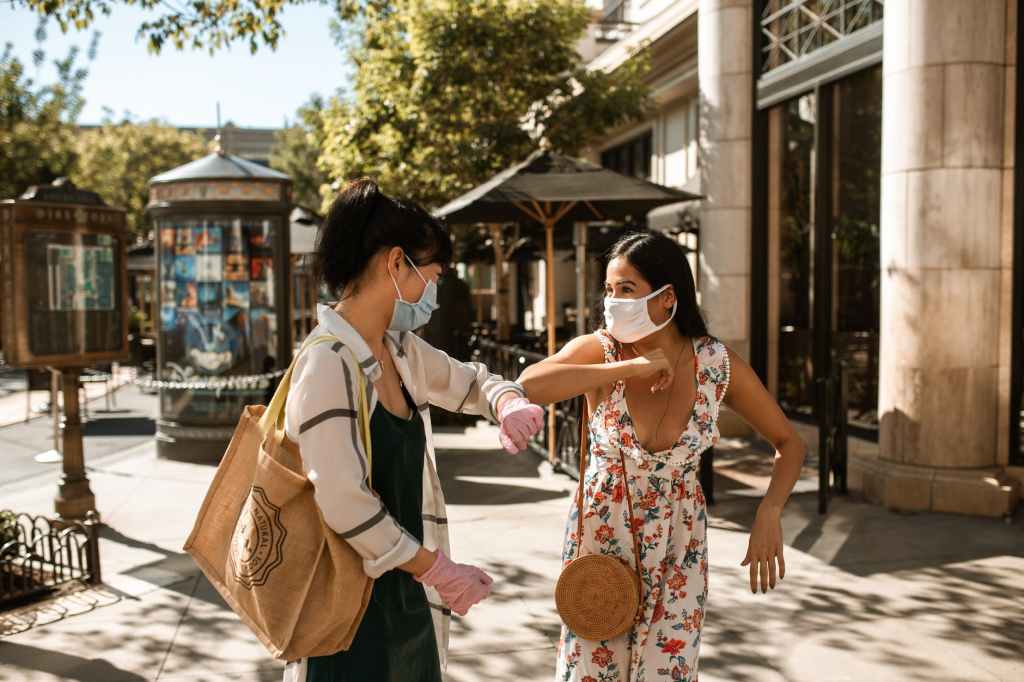
Well 2020 was really something, wasn’t it? It was early in March when the pandemic began having its influence over how we are with one another, and we were already on rocky ground. I went to pick my mom up from church one Sunday before it all closed down. She introduced me to her pastor and when I put my hand out, she offered me an elbow and said, “This is what we’re doing this season.” It was my first introduction to this brave new world, and I didn’t take kindly to it. As I walked away from that social interaction, I caught myself muttering an unflattering pejorative and asking my mom if the pastor had broken the bread for communion and handed it to her. When she said yes, I muttered some more.
In a mere twinkling, we lost handshakes, hugs, high-fives, and fist bumps. Then a little later, when masks became double-plus-good for keeping us all safe, we lost facial expressions.
I can’t say that I have ever been a willing proponent of the elbow bump. I have no doubt that it’s related to my less than stellar introduction to the custom. I’ve maybe used it a handful of times. When I HAVE had the occasion to use it, my elbow partner and I carried it out with a good deal of cynicism and mockery. Oh well, it got a cheap laugh.
I have a lot of friends who resorted to doing the Namaste bow. It’s what we say out here in the West when we have finished Sivasana in yoga class and it’s time to roll up our mats and go on to the next thing in life. People buy and wear t-shirts that say Namaste, and there are the endless ‘clever’ uses of the word that very occasionally elicit a polite chuckle. It has become a variant of Have a Nice Day.
A friend of mine visited Nepal way back in the before times. When she came home, she shared a story about how wherever she went, people would stop, place their hands palms together at the level of their chest or head and either bowed, or raised their hands in gesture of reverence saying, “Namaste.” She marveled that while walking up a trail, a woman alongside the trail set down her knitting to make the gesture and say the word to people passing by. Even people such as my friend who was a stranger to her.

Out of curiosity, my friend asked people whether it was a mindfully conscious act, or whether it was like when we Westerners tell each other to “Have a Nice Day.” The person she asked replied that yes, they really did stop and acknowledge each other. It was an intentional gesture of bowing to each other.
The word Namaste comes from Old Sanskrit. Namah is from नम् root word which means to bow , to salute ( as a mark of respect ).Te ते means to you , for you .The two words put together it means Salutation to you or I bow to you ).
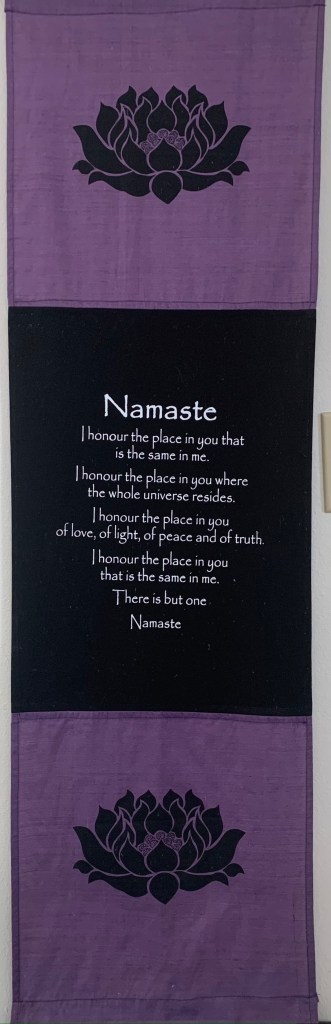
There are a lot of beautiful explanations of namaste, and I admit to having a wall hanging with the word in my living room. It has its own interpretation of the spirit of the word.
After my friend shared that story, it changed the flavor of how we experienced the ritual at the end of our intenSati classes. We took time and we really intentionally stopped to take a moment to make eye contact with each person in the other class, hold the gaze, and hold the feeling of recognizing the other person as being important to us.
There are so many ways for human beings to greet each other. When I was in grade school, we learned about Shalom from the Jewish faith. This from the Wiki: Shalom (Hebrew: שָׁלוֹם shalom; also spelled as sholom, sholem, sholoim, shulem) is a Hebrew word meaning peace, harmony, wholeness, completeness, prosperity, welfare and tranquility and can be used idiomatically to mean both hello and goodbye.
I REALLY MISS THAT.
That’s nice. Then there is the Italian “ciao.” Here’s what the Wiki has to say about that: Originally from the Venetian language, it has entered the vocabulary of English and of many other languages around the world. Its dual meaning of “hello” and “goodbye” makes it similar to shalom in Hebrew, salaam in Arabic, annyeong in Korean, aloha in Hawaiian, and chào in Vietnamese.
What all of these greetings have in common is a sense of wishing each other well.
When our interactions are reduced to online interactions such as Social Media and Zoom, what can we do to upgrade the quality of our interactions?
In thinking about all of this, and how we seem to be a country divided, I’m going to try and be mindful of my interactions on social media, on Zoom calls, and when I’m out and about in public. Online, I’m going to ask myself what I would say (or perhaps decide not to say) if that person were right there with me.
 Calm on ground